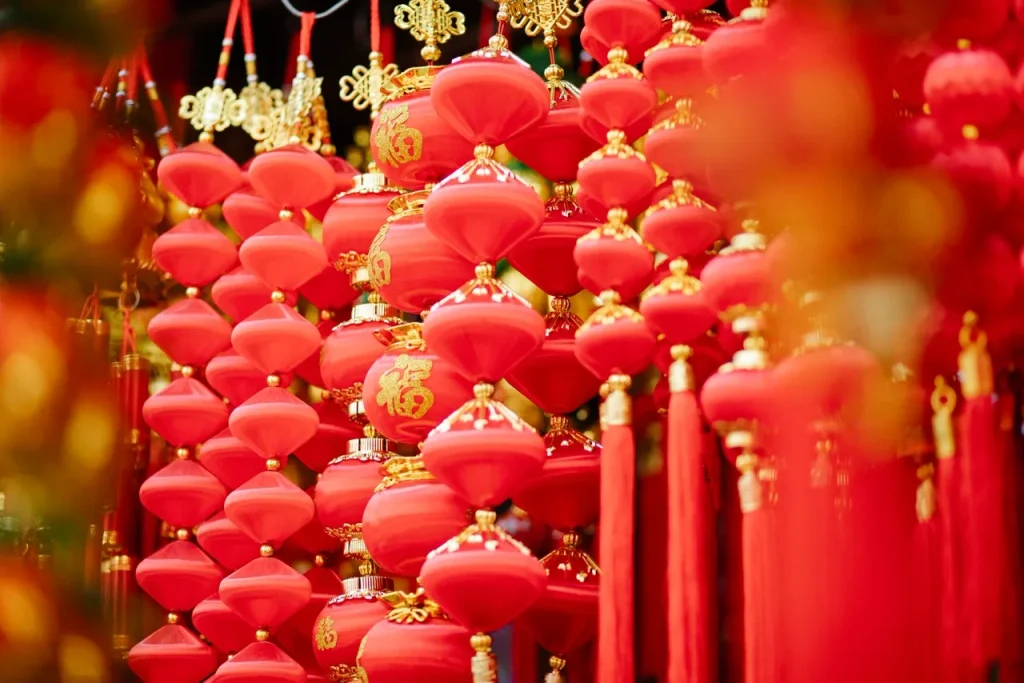
Few Chinese characters are as widely recognized as 福, commonly written as fu. You see it on red paper squares, lanterns, gift boxes, restaurant walls, phone wallpapers, and front doors during the Lunar New Year season. It is often translated as “luck,” but that single English word is too small. Fu can suggest blessing, good fortune, happiness, prosperity, and the deep wish that life will be safe and abundant.
The character is especially visible because it sits where people enter a home. A red Fu sign on a door is not only decoration. It is a public wish and a private hope. It tells visitors that the household is welcoming the new year with good intentions. It also reminds the family, each time they pass through the doorway, that blessing is something to invite, protect, and share.
What the character means
In modern Chinese, 福 appears in words related to happiness and good fortune. 幸福 means happiness or well-being. 祝福 means blessing or to offer good wishes. 福利 can refer to welfare or benefits. The character carries a warm emotional range. It is not limited to sudden luck, like winning a prize. It points more broadly toward a life that is going well: enough food, healthy family members, peaceful days, and reasons to celebrate.
The written form has a long history. Like many Chinese characters, Fu developed through earlier scripts before reaching its modern shape. People often explain its parts in folk terms, connecting the left side with spiritual offering and the right side with ideas of abundance. Scholars may describe the history more carefully, but the popular reading matters because it shows how ordinary people understand the character: blessing is linked to ritual, food, shelter, and a full life.
Why Fu is written on red paper
Red is the dominant color of Chinese New Year because it is associated with joy, celebration, protection, and vitality. A black or gold Fu character written on red paper creates an immediate festive feeling. The square shape also matters. A square red paper fits neatly on doors, windows, cupboards, and walls. It looks stable and complete.
Families may buy printed Fu signs from markets, supermarkets, temple fairs, or online shops. Some prefer handwritten calligraphy. A brush-written Fu has personality: the ink may be heavy or dry, the strokes bold or graceful, the style traditional or playful. In community events before the New Year, calligraphers sometimes write Fu characters for neighbors. People line up not because they cannot buy printed paper, but because a handwritten character feels personal. The blessing has passed through a human hand.
The upside-down Fu
One of the most famous customs is placing Fu upside down. The reason comes from a pun. In Chinese, “upside down” is 倒, pronounced dao. “To arrive” is 到, also pronounced dao. So 福倒了, “Fu is upside down,” sounds like 福到了, “blessing has arrived.” The visual joke turns the door into a wordplay greeting.
This custom is especially common on interior doors, containers, and decorations. Some families put an upside-down Fu on the main door; others say the main door Fu should remain upright because blessing should enter properly. Regional habits and family preferences differ. The disagreement itself is part of living tradition. Customs are not always fixed rules. They are conversations passed down through households.
A symbol that travels well
Fu is popular partly because it is easy to recognize even for people who do not read much Chinese. The character’s shape becomes an image. Designers place it inside circles, combine it with zodiac animals, weave it into paper-cut patterns, or print it on red envelopes. In overseas Chinese communities, Fu decorations often appear in shops and homes during the New Year, helping create a shared festive atmosphere across different languages and dialects.
For language learners, Fu is a good example of how Chinese characters carry cultural life beyond dictionary meaning. Learning the pronunciation and translation is only the first step. The richer understanding comes from seeing where the character appears, when people display it, how they talk about it, and why a family may save one particular calligraphy piece for years.
Everyday hopes behind the sign
What does a family want when they paste Fu on a door? The answer may be ordinary, and that is why it is moving. They want children to grow well, elders to stay healthy, work to be steady, debts to be manageable, meals to be shared, and arguments to pass quickly. In a festival season filled with fireworks, banquets, travel, and red envelopes, the Fu character quietly gathers these hopes into one sign.
It is also a reminder that Chinese New Year is not only about looking backward to tradition. Every year, the same character is pasted again in a slightly different life. A new apartment, a first job, a baby in the family, an elder missing from the table, a business trying to survive, a student leaving home: Fu meets all of these moments. The character stays the same, but the wish changes with the people who hang it.
How to appreciate Fu respectfully
If you see a Fu decoration, notice its setting. Is it handwritten or printed? Upright or upside down? On a front door, a shop counter, a window, or a gift package? Is the style formal, cute, luxurious, or homemade? These details tell you how tradition moves between ceremony and daily life.
For anyone learning about Chinese language and symbols, Fu offers a perfect starting point. It shows how a character can be a word, an image, a joke, a blessing, and a seasonal ritual all at once. Most of all, it shows that luck in Chinese culture is rarely imagined as something purely individual. Fu is pasted where people live together. It belongs to the doorway, the family, and the hope that good things will arrive for everyone inside.